01 / Market
Secure storage, on demand
People and small businesses need flexible, secure, short-term storage more than ever — but the market almost exclusively sells it by the month. That gap is what this system demonstrates a working answer to.
Sources: Research and Markets · Mordor Intelligence · Storeganise industry report
02 / System
Four systems, one loop
Not a courier/parcel flow — an account-based rental system. Four things this demonstrates, named explicitly:
Electronics
Per-box lock + door-sensor hardware, aware in real time of open/closed state for every compartment.
The server
Dispatches unlock commands to a specific machine/box, and is the single source of truth for which boxes are occupied and who holds each one.
The user app
Account creation, "get me a locker," view your active box, retrieve, and authorize a different account to retrieve on your behalf.
The admin app
Fleet-wide view of every machine's box occupancy and health, independent of the user-facing app.
- User creates an account in the app.
- At (or near) the machine, they ask the app for a locker — the app sends the request to the server.
- The server picks an available box and sends it an unlock command — the machine doesn't decide this locally.
- The door opens; they deposit their item and close it. The server marks that box occupied, owned by them, timestamped.
- Later, they reopen the app and request their box back — same server-driven unlock.
- Or, they authorize a second account to retrieve instead — the server checks that authorization before granting the unlock to anyone else.
- On retrieval, the box is marked empty again.
03 / App
The app, screen by screen
Real interface designs for the four moments that matter — not just described, drawn. The same four screens show up again during the 3D walkthrough above, at the step each one belongs to.
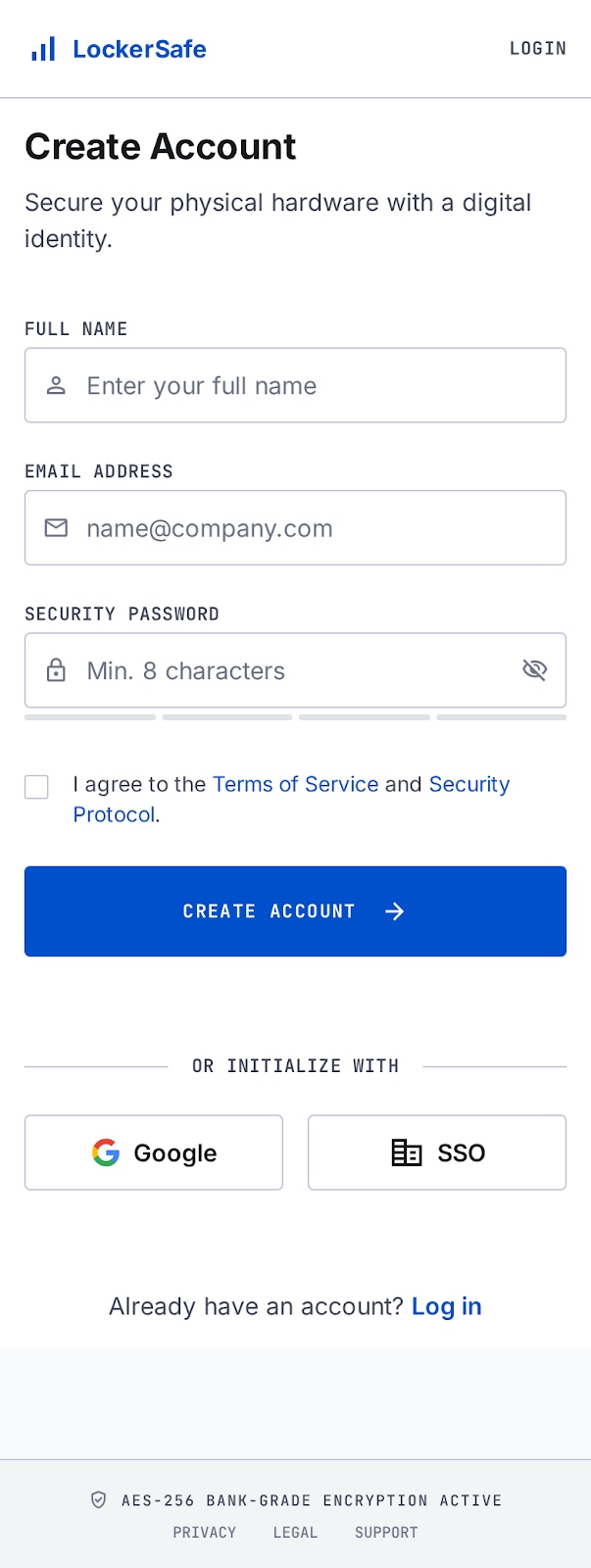
Create account
Secure your physical hardware with a digital identity.
01 / 04
Swipe to navigate
04 / Proof
What's already built
This isn't a slide-deck concept. There's a complete engineering blueprint behind it — every part of the system, designed end to end — plus the live interactive proof running right above, not a separate rendering:
Mechanical
The complete physical structure — cabinet, frame, and every compartment — fully modeled and dimensioned, not a rough sketch.
Electrical
The complete hardware architecture — power, connectivity, sensing, and control — specified end to end.
Software
The complete system design — server, user app, admin app, and the firmware tying them together.
Live & interactive
The model above runs off this exact design — open doors, see inside, peel back the shell — with 53 automated checks that re-verify it stays correct as it changes.
05 / Hardware
What it's built from
Built entirely from generic, off-the-shelf electronics — nothing proprietary, nothing hard to source or replace.
| Part class | Status | Notes |
|---|---|---|
| Cabinet fabrication, structural frame | Candidate | Same cabinet/skeleton class as the archived estimate |
| Door hardware (hinge, latch, sensor) | Candidate | The door sensor is what makes real-time occupancy tracking possible |
| Microcontroller | Locked | Off-the-shelf part, widely available |
| Single-board computer + storage | Locked | Off-the-shelf part, widely available |
| 4G / network connectivity | Candidate | Central — the server-driven unlock model depends on it |
| Cameras (×2) | Candidate | |
| Power supply + backup power | Candidate | |
| Display | Open | Ambient status screen, not an action menu — the app drives the interaction |
| Keypad | Candidate | Optional fallback (e.g. staff override), not primary |
| Wiring, anchors, assembly labor | Candidate |
For one machine — own researched pricing (Shopee Malaysia, mid-2026), not a vendor quote.
Typical smart-locker hardware per unit — even this prototype's high end sits below the market's low end. (Converted from the source's €6,000–25,000 at ≈RM 5.0/EUR — Parcelhive pricing.)
06 / Economics
Two honestly-labeled scenarios
Day-rates anchored to real self-storage pricing (national average ≈ RM 420/month ≈ RM 14/day, real range RM 140–1,325/month ≈ RM 4.70–44/day — converted from the sources' USD figures at ≈RM 4.7/USD: SpareFoot, Angi), not an invented number. No sourced rate exists for short-term/on-demand smart-locker rental specifically — the rates below are illustrative picks within that real range, not a researched benchmark. Same 32-box configuration as the CAD above.
Conservative
Optimistic
Neither scenario is a prediction — they show the shape of the economics under honestly-labeled assumptions. The real unknowns: actual achievable occupancy (no data exists yet, this is a new deployment) and what rate this specific product could actually command versus monthly self-storage.
07 / Integrity
What "tamper-evident" actually means here
Every locker request, deposit, and retrieval is logged in a hash-chained, append-only record — each entry's hash folds in the previous entry's hash, so altering any past record breaks every hash after it (the same structure git commit history uses).
hash 9f3a…
prev 9f3a… · hash c71d…
prev c71d… · hash 5be2…
This is not a multi-party blockchain — that solves a consensus problem a single-operator deployment doesn't have. What it does give: a tamper-evident audit trail — who held which box, when, and who they authorized to retrieve it — that an operator or auditor can verify independently. The honest description is "tamper-evident ledger," not "runs on blockchain."
08 / Advantages
Why this is worth a conversation
- 01Real, working parametric CAD + live interactive demo — not a concept render. Almost no early-stage hardware concept can back itself up like this.
- 02Meaningfully cheaper than market-rate smart locker hardware — sourced, not asserted.
- 03The account / delegation / server-driven-access model is a genuinely different, more useful interaction than a fixed-code parcel locker — shared and delegated access, indefinite hold, no external code to lose.
- 04Demonstrates the full stack — electronics, server, user app, admin app: one person capable of the whole system, end to end.
- 05Already proven configurable across two very different use cases — the same underlying platform already shifted once, with no redesign of the physical machine.
09 / Contact
Ahmed Adel Mahdy
I designed and built this — the CAD, the electronics concept, and everything you saw moving above. I can build the rest (server, apps, firmware) and maintain it too. If you want to talk about this for a real deployment, message me.
WhatsApp +60 11-2175 3409 · ahmedcareer28@gmail.com